

An Aforza point of view on Bain’s RGM Reset: Capabilities for a Competitive Edge
The 5% who get it right share one thing in common
Bain’s recent piece on revenue growth management lands on a sobering statistic: only 5% of CPG companies are getting RGM right. The rest oscillate between two extremes Bain captures perfectly. Overly complex “black box” solutions that promise precision but never scale. And simplistic dashboards that achieve adoption but cannot survive the dynamic reality of today’s market. Most companies end up with costly systems abandoned the moment the consultants leave, or tools that persist on the shelf without driving any real growth.
🔗 Bain & Company – RGM Reset: Capabilities for a Competitive Edge
The Bain framework is sound. Five capability pillars, a build-and-buy mindset, agentic AI in service of RGM professionals, and the principle that the best RGM eventually becomes invisible, woven into the fabric of how the organisation works every day. We agree with all of it. The question we want to add is this: invisible to whom?
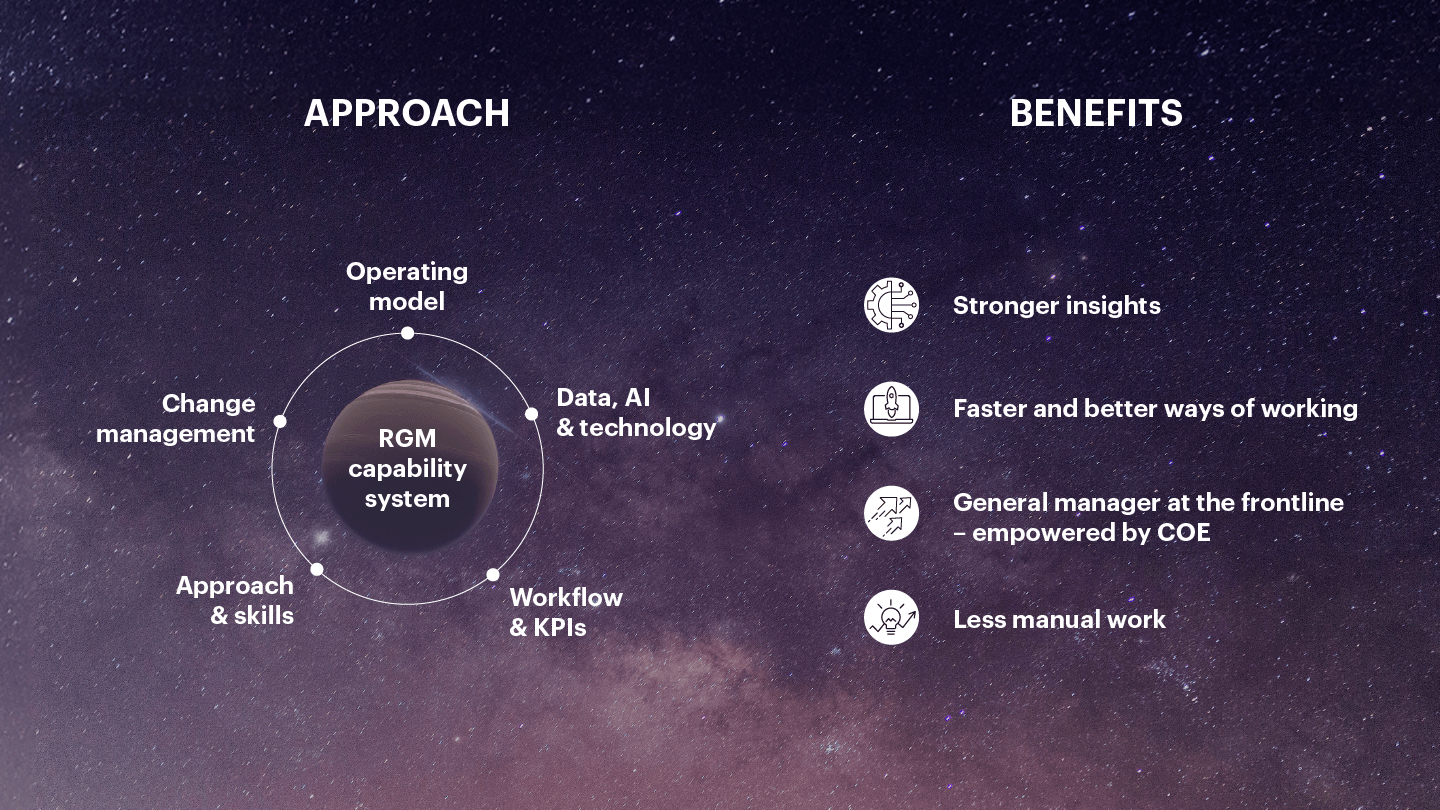
Reference: Bain & Company – RGM capabilities accelerate commercial performance and generate a competitive advantage
The gap Bain doesn’t quite close
Bain’s framework is largely written from the head office down. Operating model, data and technology, workflow and KPIs, approach and skills, change management. These are the levers a Chief Commercial Officer pulls. They are real, and they matter. But none of them, on their own, change what happens at 11:42am on a Tuesday morning when a field rep walks into a store and has to decide whether to push the new SKU at the recommended price or default to last quarter’s deal because that is what the buyer expects.
That moment is where RGM either lands or evaporates. We see it across hundreds of CPG implementations. The pricing strategy is right, the promotional calendar is right, the trade investment model is right, and yet the retail execution layer flattens it all into a generic visit. The rep does not know which of the seventeen actions on their screen actually drives the category profit pool. The KPIs Bain rightly calls out as critical never reach the person who has the customer in front of them.
This is the second uncomfortable truth Bain alludes to but does not fully name. Most RGM transformations stall not because the data model is wrong, or because the workflows are inconsistent, although both happen. They stall because the last mile of execution, the moment the rep stands in front of the shelf or the buyer, is treated as a separate domain. RGM lives in head office tools. Execution lives in CRM. The two systems rarely share a sentence, let alone a decision.
What invisible RGM actually looks like in the field
Bain’s principle that RGM should become invisible is the right one. We would push the definition further. Truly invisible RGM is not just an embedded routine for the trade marketing manager planning next quarter’s investment. It is a real-time prompt to the field rep, in the language of their next action, that reflects the full RGM logic without ever showing them a pricing model.
What does that look like in practice? A rep arrives at a store. The system already knows the account’s role in the trade investment plan, the SKUs at risk of distribution loss, the promotion that needs validation today, and the price gap versus the nearest competitor. Instead of seventeen tasks, the rep sees three: validate the promotion compliance with a photo, place the order on the new SKU at the recommended price, and capture the buyer’s reaction to the planogram change. The pricing logic, the trade investment model, and the category profit pool calculation never appear on the screen. They are the rails the recommendation runs on.
This is the Bain principle, applied one layer deeper than the framework reaches on its own. Bain rightly says that “human plus AI” is the next frontier, with agentic AI surfacing insights and guiding decisions at speed. We agree. The opportunity is to extend that frontier from the RGM professional to the rep in the aisle, the merchandiser auditing the shelf, and the distributor partner managing secondary sales. The same agentic logic, applied at the point of execution.
Reasons to believe
Aforza was built for this gap. Ava, our agentic AI built natively into the Aforza commercial execution platform, runs on the same Salesforce data model that holds account, pricing, promotion, and trade investment data. There is no integration layer to maintain, no synchronisation lag, and no separate execution database to reconcile. The result is that RGM logic, whether it sits in a Bain-style five-pillar transformation or an existing in-house model, can flow directly into the rep’s next action.
We see the impact in customer outcomes. Across recent deployments at L’Oréal, LEGO, Asahi, Lee Kum Kee, Super Bock Group, AG Barr and Alicorp, the pattern is consistent: faster guidance in the field, better promotional compliance, and measurable improvement in category profit pool contribution from the accounts under active execution.
What this looks like in practice
At Aforza, we built Ava, our vertical AI agent, specifically for this reason. Ava lives inside the commercial processes that CPG companies run every day: retail execution, trade promotion management, distributor management, deductions, field sales coaching. She operates natively inside Salesforce, where the customer, account, and commercial data already sits, which removes the integration tax and most of the security friction that blocks horizontal AI.
The results are already visible in customers that have put Ava in front of their commercial teams. AG Barr, the UK drinks group behind Irn-Bru and Rubicon, cut the time spent in each store visit from around 20 minutes to roughly 7, reallocating the time to genuine coaching and execution quality. That’s not an AI pilot. That’s an AI agent changing a core commercial process. It’s the kind of outcome that makes the ROI conversation short.

The pattern generalises. Whether the application is image recognition for shelf audits, an AI-drafted trade promotion, a deduction automatically matched to its root cause, or a sales rep briefed by Ava before every visit, the common thread is the same: the agent owns a specific commercial job, the outcome is measurable, and the customer doesn’t need an internal AI team to operate it.

This is where Aforza has done something no other CPG platform has. The Ava Library is the industry’s first packaged library of agentic AI use cases purpose-built for consumer goods. Not a toolkit. Not a set of APIs waiting for a systems integrator to assemble. A living library of pre-built agents that already know how to review a store visit for perfect store compliance, validate a retailer deduction against the originating trade promotion, surface the next best action for a key account, draft a promotional plan from post-event ROI, reconcile distributor sell-out data, and dozens of other jobs that sit at the heart of the CPG commercial day.
🔗 You can download a copy of the Ava Library here
This matters because it directly addresses the common barriers identified as blocking AI adoption. Security concerns recede because every agent in the Library runs inside the customer’s existing Salesforce platform, on infrastructure their CIO has already approved. The expertise gap closes because the agents are pre-built for CPG use cases; commercial teams consume them, they don’t build them. And the ROI question answers itself when every agent is tied to a specific commercial job with a measurable outcome attached.
A question worth asking before the next RGM cycle
Bain’s closing observation, that the future of RGM is not a programme but how the business runs, is the right one. The harder question is whether the business runs all the way to the aisle. If the RGM model is brilliant in head office and silent in the field, the 95% statistic will not move. The 5% who get it right will be the companies that treat retail execution as the final pillar of the framework, not the place where the framework gets translated and lost.
If you are mid-way through an RGM reset, the diagnostic worth running is simple. Walk into a store with one of your reps. Ask them what their three most important actions are today and why. Then compare their answer to the strategy your RGM model says they should be executing. The gap between those two answers is the size of the prize.
We would be glad to share how the most operationally mature CPG companies are closing it.
Commercial Excellence Exchange
For more insights like this, join the Commercial Excellence Exchange, our community for leaders across Commercial Excellence, Sales Excellence, Field Effectiveness, Sales Effectiveness & Commercial Performance in the Consumer Goods industry.