

What is Aforza Data 360?
Aforza Data 360 is the consumer goods semantic layer built on Salesforce Data 360. It gives retailer point-of-sale data, syndicated market data, distributor sell-through, ERP records and field execution activity a shared industry meaning: one product hierarchy, one outlet hierarchy, one definition of a promotion, a distribution gap or a perfect store. That shared meaning is then available to every planning, selling and AI workflow a commercial team uses.
The distinction matters. Salesforce Data 360 solved the platform problem: how to unify enterprise data without copying it, and how to make it available everywhere across Salesforce. Aforza Data 360 solves the problem that sits directly on top of it. Unified data still has to mean something. A unified customer record is useful. A shared, governed definition of the product, the outlet, the shelf, the promotion and the distributor is what actually runs a consumer goods business.
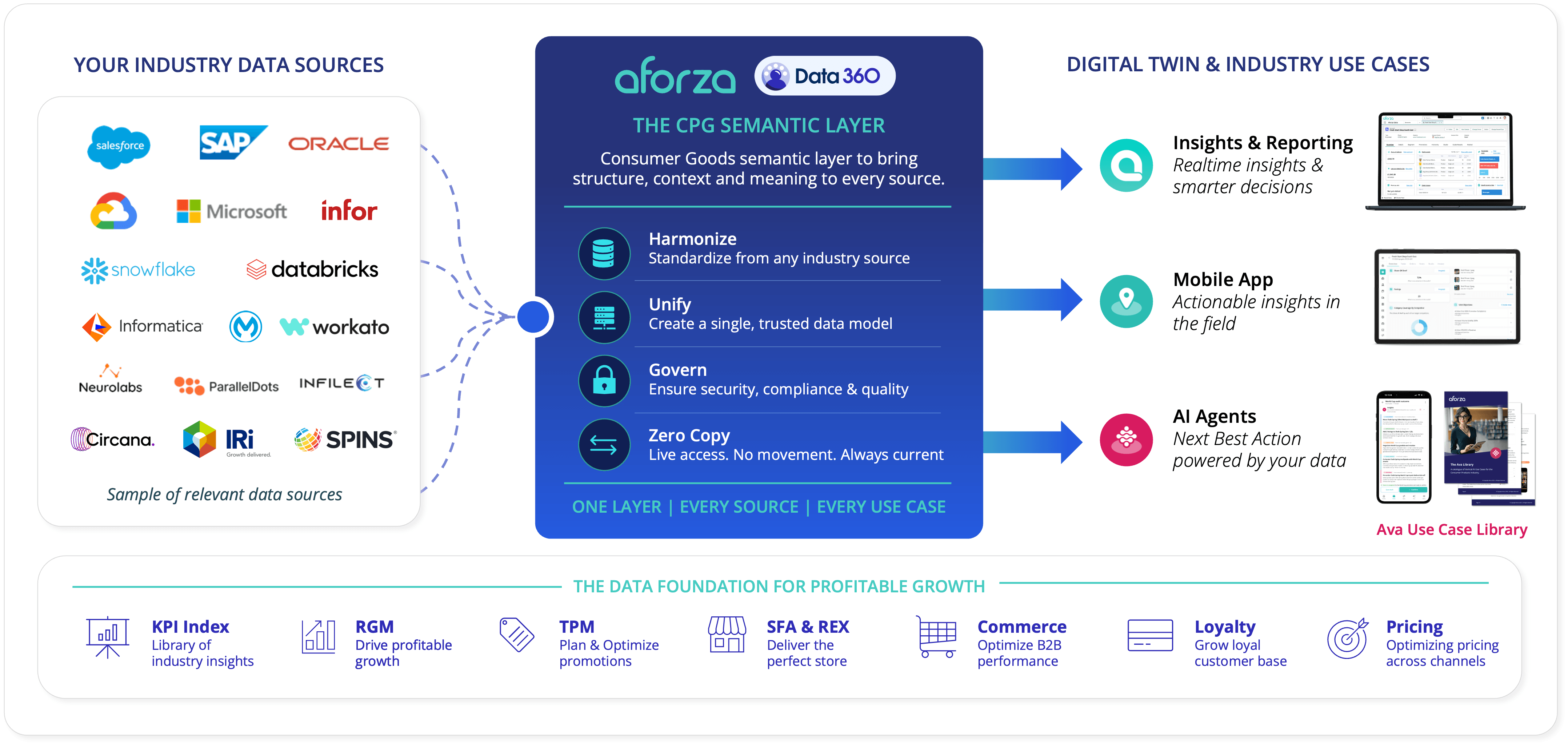
One layer, every source, every use case.
Why do consumer goods companies need a semantic layer built for the industry?
Because the data a consumer goods company needs to make a commercial decision almost never lives in one place, and almost never means the same thing twice.
Consider a single, ordinary question: is this promotion working? Answering it properly means pulling shipment data from the ERP, sell-through from the distributor, scan data from the retailer portal, category context from a syndicated provider, and execution evidence from the field. Five systems, five product hierarchies, five refresh cycles, five definitions of what a “store” is. Syndicated feeds arrive a week or two behind. Retailer portals such as Walmart Retail Link, Kroger Stratum and Target POL each format their data differently. Field execution data sits in a mobile app that nobody has connected to any of it.
So the question gets answered slowly, partially, and in a spreadsheet that three people quietly disagree with.
This is not a failure of effort. It is a structural problem, and it is why AI has been slow to deliver in consumer goods. MIT’s NANDA research found that 95% of enterprise generative AI pilots produced no measurable impact on the P&L, and the cause was not model quality. It was that the systems underneath had no reliable context to work from. An AI agent asked to recommend a promotion is only as good as the data it can reach and trust. Point an agent at five disconnected systems and it will produce something confident and wrong.
What data sources does Aforza Data 360 connect to?
Aforza Data 360 connects to the sources consumer goods companies actually run on, both inside and outside Salesforce:
Syndicated market data
NielsenIQ, Circana and SPINS, for category share, competitor performance, pricing and channel benchmarks
Retailer POS & vendor portals
Walmart Retail Link, Kroger Stratum, Target POL and equivalent regional portals
ERP & core business systems
SAP, Oracle, Microsoft and Infor, for shipments, pricing, trade accruals and deductions
Data warehouses & lakes
Snowflake, Databricks and Google Cloud, accessed live rather than copied
Integration & middleware
Informatica, MuleSoft and Workato, where a company has already standardised on them
Image recognition providers
Neurolabs, ParallelDots and Infilect, converting shelf photography into structured shelf data
Distributor & wholesaler data
Sell-in, sell-through, stock positions and secondary sales from route-to-market partners
Aforza execution data
Visits, audits, orders, planogram compliance, promotional execution and claims
That image recognition line matters more in consumer goods than in almost any other industry. A field team of 300 reps generates hundreds of thousands of shelf images a year. Those images contain the answer to every distribution, share of shelf and compliance question the business asks, and in most companies they sit in storage, unread. Aforza Data 360 treats image and document content as a first-class source, converting it into structured signals that sit alongside sales data rather than in a separate reporting silo. The same applies to planograms, trade terms, joint business plans and customer contracts.
How does Aforza Data 360 work?
Aforza Data 360 works through four principles: harmonise, unify, govern and zero copy.
Harmonise
Standardise from any industry source. A Circana category read, a Walmart Retail Link extract and a rep’s shelf audit arrive in three different shapes. Harmonisation maps them to a consumer goods model: global product hierarchy and GTIN, outlet and store hierarchy, customer and banner hierarchy, promotion, channel, territory and route.
Unify
Create a single, trusted data model. This is where the semantic layer earns its name. On top of the harmonised structure sit the metrics the business actually argues about, defined once and governed centrally: distribution gap, share of shelf, perfect store, promotional lift, on-shelf availability, effective trade spend. Promotional lift then means the same thing in the field, in trade marketing and in finance.
Govern
Ensure security, compliance and quality. Classification, policy enforcement, masking and access control apply consistently across structured and unstructured data, so a distributor sees their data and only their data, and a market team sees theirs.
Zero copy
Live access, no movement, always current. Data in Snowflake, Databricks or an existing warehouse is used where it lives rather than duplicated into another system, which removes both the pipeline maintenance and the reconciliation argument that follows every copy.
Where does the data go to work?
A semantic layer that only feeds a dashboard has not earned its cost. Aforza Data 360 activates in three places:
Insights & reporting
Real-time visibility and faster decisions, built on numbers the whole business shares.
Mobile
Actionable insight in the field, on a device that works offline, so the rep arrives at the store already knowing what the data knows.
AI Agents
Next best action powered by the company’s own data rather than a general model’s guess.
Together these create a working digital twin of the commercial operation: the products, outlets, shelves, promotions and distributors represented accurately enough that you can ask questions of the model instead of the market.
What business processes does Aforza Data 360 support?
The same semantic layer supports every commercial process on the platform, which is what stops each one from building its own version of the truth:

Revenue Growth Management (RGM)
Revenue growth management decisions grounded in harmonised market and internal data.
Trade Promotion Management (TPM)
Promotion planning and optimisation against real execution and scan data.
Sales Force Automation (SFA) & Retail Execution (REX)
Real-time next best action in the store, with the rep told what to do at the shelf while the visit is still happening.
B2B Commerce
B2B ordering and portal performance connected to the same customer hierarchy.
Retailer Loyalty
Programme performance measured on the same outlet and customer model.
Pricing
Price and margin decisions consistent across channels and markets.
Is Aforza Data 360 a customer data platform?
It’s much more than that. Customer data platforms were built to unify consumer profiles for marketing activation. Aforza Data 360 is a commercial data engine for consumer goods, where the units of value are the product, the outlet, the shelf, the promotion and the distributor. The questions it answers are commercial ones: where are we losing distribution, which promotions are destroying margin, which stores need a visit this week, and which deduction claims are valid.
How does Aforza Data 360 power Ava?
Ava, Aforza’s consumer goods AI, runs on it. Agents ground their answers in harmonised, governed data through retrieval rather than guessing from a general model. Ava REX recommends the next best action in-store because it can see the store’s execution history and the category read together.
Ava TPM recommends promotional investment because it can see spend, shipment, scan and execution data in one place. Ava Claims validates deductions against the trade terms document and the actual execution evidence. Ava Custom Agents extend the same grounding to customer-specific use cases, drawing on the Ava Use Case Library.
The pattern is consistent: an agent can only reason as well as the meaning it is given, which is why the semantic layer came first.

Where to start?
The useful diagnostic is not “do we have a data strategy”. It is narrower than that. Pick your last significant promotion, and time how long it takes your team to produce a single agreed number for its return. If the answer is measured in days, and if two teams arrive with two different numbers, the constraint is not analytics talent. It is that nobody agreed what the number meant.
If you want to see what that looks like fixed, book a walkthrough of Aforza Data 360 and bring your hardest reconciliation question with you.
Frequently Asked Questions (FAQ)
What is Aforza Data 360?
Aforza Data 360 is the consumer goods semantic layer built on Salesforce Data 360. It gives retailer POS, syndicated market data, distributor sell-through, ERP and field execution data one shared industry meaning, then activates it in commercial workflows and AI agents.
Is Aforza Data 360 the same as Salesforce Data 360?
No. Salesforce Data 360 unifies and governs enterprise data. Aforza Data 360 is built on it and adds the consumer goods semantic layer: industry hierarchies for product, outlet, promotion, channel and distributor, governed metric definitions, and connectors specific to consumer goods.
What is a semantic layer in consumer goods?
A semantic layer is the business meaning applied on top of unified data: which hierarchies apply, how entities relate, and how metrics are defined. In consumer goods it governs product, outlet, promotion and distributor hierarchies, and metrics such as distribution gap, perfect store and promotional lift.
Which syndicated data providers does Aforza Data 360 support?
Aforza Data 360 can connect to all of your syndicated providers including NielsenIQ, Circana and SPINS, alongside retailer vendor portals such as Walmart Retail Link, Kroger Stratum and Target POL.
Does Aforza Data 360 require moving data into Salesforce?
No. Zero copy means live access with no data movement, so data already held in Snowflake, Databricks or an existing warehouse stays where it is and remains current.
What are the four principles of Aforza Data 360?
Harmonise, standardising data from any industry source. Unify, creating a single trusted data model. Govern, ensuring security, compliance and quality. Zero copy, giving live access with no data movement.
Which business processes does Aforza Data 360 support?
Revenue growth management, trade promotion management, sales force automation and retail execution with real-time next best action, B2B commerce, loyalty and pricing, all working from the same governed definitions.
How does Aforza Data 360 relate to Ava?
Ava, Aforza’s consumer goods AI, is grounded in Aforza Data 360. Agents retrieve harmonised, governed data rather than relying on a general model, which is what makes their recommendations specific and defensible.
Who is Aforza Data 360 for?
Consumer goods manufacturers and distributors running field sales teams, trade promotions or route-to-market operations, typically in food, beverage, beauty, household goods, pet, consumer healthcare and tobacco.
Commercial Excellence Exchange
For more insights like this, join the Commercial Excellence Exchange, our community for leaders across Commercial Excellence, Sales Excellence, Field Effectiveness, Sales Effectiveness & Commercial Performance in the Consumer Goods industry.